Build AI systems that actually ship
Build production-ready AI systems that can handle real users, failures, automation, agents, data, and deployment.

“Stop building demos. Start building AI systems that can hold up in the real world.”
— Cyberical Academy

What you'll learn
What you'll be able to do
- Build Python systems that stay organized as they grow.
- Design AI architectures that can recover when components fail.
- Test AI agents with evidence instead of assuming they work.
- Run automations reliably without duplicate actions or silent failures.
- Coordinate specialized AI agents without losing control of the system.
- Deploy AI applications built for real users, not just demos.
- Use Playful Logic challenges to pressure-test AI systems, compare approaches, uncover failures, and prove what actually works.
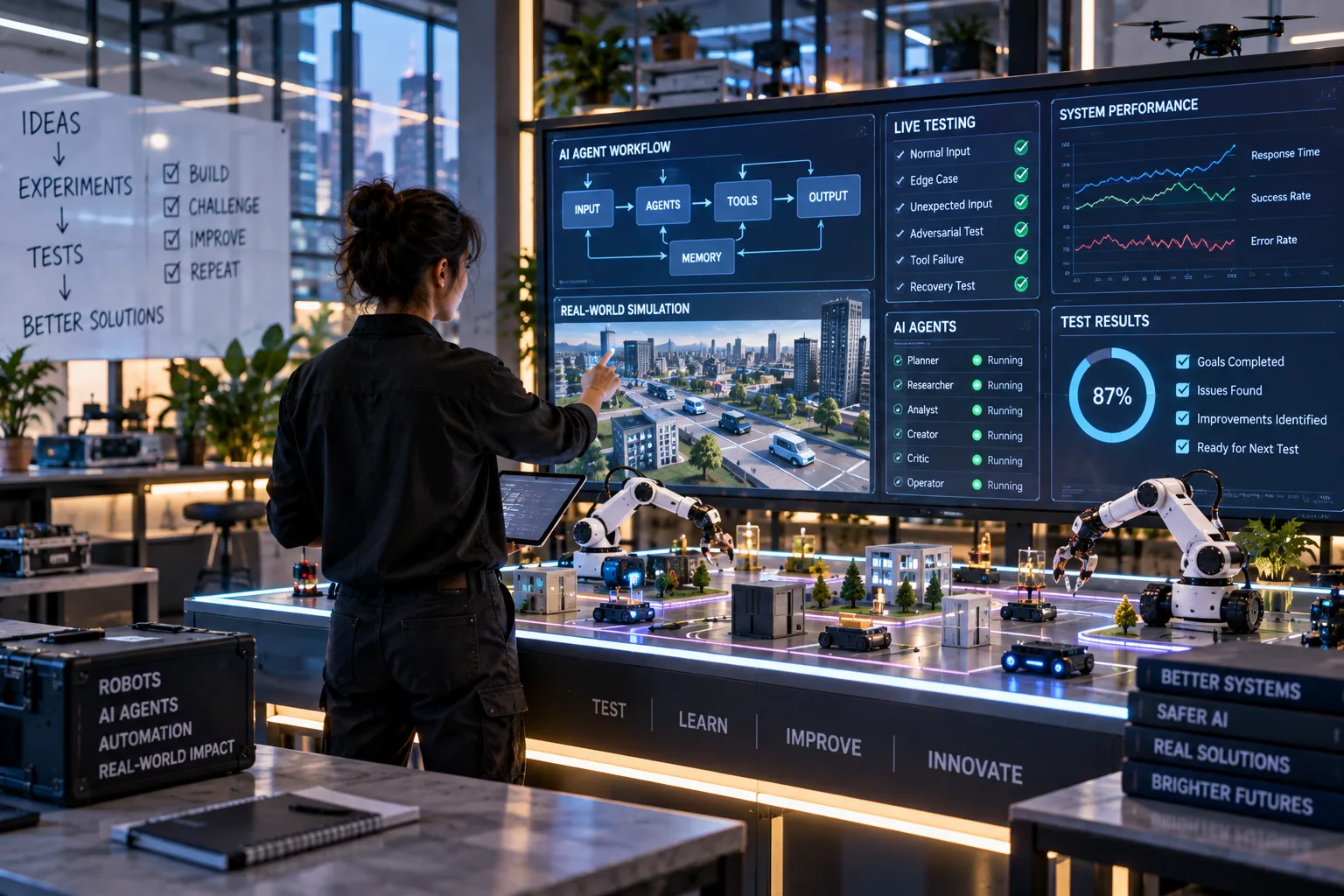
Challenge It. Test It. Prove It.
Cyberical Academy uses the Playful Logic approach to turn advanced AI concepts into active experiments. Instead of only studying architecture, agents, products, research, and safety, you will challenge assumptions, test competing approaches, find failure points, and use evidence to decide what works.
Challenge It
Question the assumptions behind an architecture, agent, product, or experiment.
Pressure-Test It
Push systems with difficult inputs, failures, unusual users, and unexpected conditions.
Compare It
Test different approaches using the same criteria instead of relying on instinct.
Prove It
Use evidence, evaluation, and real results to show whether your decisions actually improved the system.
How it works
Build. Test. Strengthen. Ship.
Every part of the program moves your system closer to something that can work outside a controlled demo.
Build the system
Design the architecture, components, agents, automations, and application your project actually needs.
Test what breaks
Use real inputs, failure cases, evaluation, and user testing to find weaknesses before release.
Strengthen and release
Improve reliability, safety, performance, and usability until the system is ready for real use.
The curriculum
What's inside your school
0 modules · 0 lessons

Advanced Python and Software Architecture
Build the architectural foundation for production-level Python systems using advanced OOP, clean module boundaries, and maintainable design patterns.
- 1.1Design Python Programs That Can Grow Into Larger SystemsIncluded
- 1.2Use Advanced Classes and Object-Oriented Design to Organize Complex ProgramsIncluded
- 1.3Apply Inheritance and Composition to Build Reusable Software ComponentsIncluded
- 1.4Use Type Hints and Clear Interfaces to Make Code Easier to UnderstandIncluded
- 1.5Organize Large Python Projects Into Packages and ModulesIncluded
- 1.6Separate Responsibilities Across Different Parts of a Software SystemIncluded
- 1.7Refactor Existing Code to Make It Cleaner, Stronger, and Easier to MaintainIncluded
- 1.8Build the Architecture for a Production-Level Python ProjectIncluded
Design Complex AI Systems
Plan, diagram, and architect multi-component AI systems with defined responsibilities, clean APIs, and built-in failure recovery.
- 2.1Understand How Complex AI Systems Are Divided Into ComponentsIncluded
- 2.2Define Clear Responsibilities for Each Part of an AI SystemIncluded
- 2.3Design How Data and Instructions Move Between ComponentsIncluded
- 2.4Use APIs and Interfaces to Connect Different Parts of a SystemIncluded
- 2.5Identify Dependencies That Could Make a System FragileIncluded
- 2.6Design Systems That Can Recover When Individual Components FailIncluded
- 2.7Create Architecture Diagrams Before Building Complex AI SystemsIncluded
- 2.8Design the Architecture for Your Own Generated AI SystemIncluded
Evaluate and Improve AI Agents
Build rigorous evaluation frameworks that measure agent accuracy, reliability, and reasoning quality — then use results to drive improvement.
- 3.1Define What Successful Agent Behavior Looks Like Before TestingIncluded
- 3.2Create Test Tasks That Measure Whether an AI Agent Works CorrectlyIncluded
- 3.3Measure Agent Accuracy, Reliability, and Task CompletionIncluded
- 3.4Identify Where an Agent's Reasoning or Actions Break DownIncluded
- 3.5Test AI Agents With Difficult and Unexpected InputsIncluded
- 3.6Compare Different Agent Designs Using Consistent Evaluation CriteriaIncluded
- 3.7Use Evaluation Results to Improve Agent Prompts, Tools, and LogicIncluded
- 3.8Build an Evaluation System for an AI AgentIncluded
Build Automation Systems at Scale
Construct robust automation pipelines with event queues, retry logic, idempotency, monitoring, and human override controls.
- 4.1Turn a Multi-Step Process Into a Complete Automation SystemIncluded
- 4.2Use Events and Triggers to Coordinate Automated ActionsIncluded
- 4.3Build Queues to Manage Multiple Tasks and RequestsIncluded
- 4.4Design Automations That Can Retry Failed Tasks SafelyIncluded
- 4.5Prevent the Same Automated Action From Running Twice by MistakeIncluded
- 4.6Add Monitoring and Logging to Track Automated WorkIncluded
- 4.7Design Human Approval and Override Controls for High-Risk ActionsIncluded
- 4.8Build an Automation System That Can Run Reliably With Minimal SupervisionIncluded
Build Advanced Agent Ecosystems
Orchestrate multi-agent ecosystems where specialized agents collaborate, share memory, recover from failures, and remain under safe human supervision.
- 5.1Design an Ecosystem of AI Agents With Different Specialized RolesIncluded
- 5.2Decide When Agents Should Work Independently and When They Should CollaborateIncluded
- 5.3Design Communication and Handoff Rules Between AgentsIncluded
- 5.4Use an Orchestrator to Coordinate Complex Multi-Agent WorkIncluded
- 5.5Give Different Agents Access to Different Tools, Memory, and InformationIncluded
- 5.6Manage Shared and Private Memory Across Multiple AgentsIncluded
- 5.7Detect Conflicts, Loops, and Failures Inside an Agent EcosystemIncluded
- 5.8Add Human Oversight to Important Agent DecisionsIncluded
- 5.9Build an AI Agent Ecosystem That Completes a Complex GoalIncluded
Build Production-Level AI Apps
Ship a full production AI application — front end, back end, and AI layer — designed for real users, real load, and real failure conditions.
- 6.1Turn an AI Prototype Into an Application Designed for Real UsersIncluded
- 6.2Design the Front End, Back End, and AI Components of an ApplicationIncluded
- 6.3Connect AI Agents and Automation Systems to an App InterfaceIncluded
- 6.4Manage User Data and Application State SafelyIncluded
- 6.5Design Clear Responses When AI Is Slow, Uncertain, or WrongIncluded
- 6.6Add Monitoring and Logging to Understand How an AI App PerformsIncluded
- 6.7Test an AI App Under Different Users, Inputs, and Failure ConditionsIncluded
- 6.8Improve Performance, Reliability, and User Experience Before ReleaseIncluded
- 6.9Deploy and Maintain a Production-Level AI ApplicationIncluded
Advanced AI Media Production
Direct and deliver a finished AI media production — combining image, video, voice, and music — through repeatable professional workflows.
- 7.1Develop an Original Creative Direction for an AI Media ProjectIncluded
- 7.2Create a Production System for Consistent Characters, Worlds, and StylesIncluded
- 7.3Combine AI-Generated Images, Video, Voice, Music, and SoundIncluded
- 7.4Direct AI Media Across Multiple Scenes and FormatsIncluded
- 7.5Create Consistent Characters and Environments Across a ProductionIncluded
- 7.6Build Repeatable Workflows for Generating and Managing Media AssetsIncluded
- 7.7Use Human Editing and Creative Judgment to Transform Generated MaterialIncluded
- 7.8Produce a Finished Film, Animation, Audio Production, or Interactive ExperienceIncluded
Entrepreneurship and AI Products
Turn real problems into focused AI product ideas, build and test a minimum viable product, and improve it using user feedback and evidence.
- 8.1Identify Problems That Could Be Solved With Generated AIIncluded
- 8.2Define the User or Customer Who Experiences the ProblemIncluded
- 8.3Turn a Problem Into a Clear AI Product IdeaIncluded
- 8.4Define the Value Your AI Product Will Create for Its UsersIncluded
- 8.5Decide Which Features Belong in the First Version of Your ProductIncluded
- 8.6Build and Test a Minimum Viable AI ProductIncluded
- 8.7Collect User Feedback and Identify What Needs to ChangeIncluded
- 8.8Understand Basic AI Product Costs and ResourcesIncluded
- 8.9Improve Your Product Based on Evidence Instead of AssumptionsIncluded
- 8.10Develop an AI Startup or Product ConceptIncluded
AI Research and Experimentation
Design and run AI experiments that test clear hypotheses, measure meaningful results, and turn observations into evidence-based conclusions.
- 9.1Turn an AI Question or Observation Into a Testable Research QuestionIncluded
- 9.2Form a Hypothesis About What You Expect to HappenIncluded
- 9.3Design an Experiment That Can Test Your HypothesisIncluded
- 9.4Choose Useful Measures Before Running an ExperimentIncluded
- 9.5Collect and Organize Results From an AI ExperimentIncluded
- 9.6Compare Results and Look for Meaningful PatternsIncluded
- 9.7Understand the Difference Between Evidence and AssumptionIncluded
- 9.8Document Your Methods So Someone Else Can Understand Your ExperimentIncluded
- 9.9Present an AI Research Project and Explain What the Evidence ShowsIncluded
AI Safety, Ethics, and Governance
Design safer AI systems by identifying risks, setting clear boundaries, protecting information, testing for misuse, and building responsible controls before release.
- 10.1Understand Why More Powerful AI Systems Require Stronger Safety ControlsIncluded
- 10.2Identify Risks Before Deploying an AI SystemIncluded
- 10.3Define What an AI System Is and Is Not Allowed to DoIncluded
- 10.4Protect Sensitive Information and Minimize Unnecessary Data CollectionIncluded
- 10.5Design Human Approval for Important or High-Risk AI ActionsIncluded
- 10.6Test AI Systems for Misuse and Unexpected BehaviorIncluded
- 10.7Create Monitoring and Response Plans for AI FailuresIncluded
- 10.8Document Important Decisions, Limitations, and ResponsibilitiesIncluded
- 10.9Build Safety and Governance Into an AI System Before ReleaseIncluded
Build Your Professional AI Portfolio
Build a professional portfolio that showcases your strongest AI projects, explains how they work, and presents clear evidence of your skills, decisions, and results.
- 11.1Choose Projects That Demonstrate Your Strongest AI SkillsIncluded
- 11.2Explain the Problem and Purpose Behind Each ProjectIncluded
- 11.3Document the Architecture Behind an AI SystemIncluded
- 11.4Show How Your Project Changed Through Testing and IterationIncluded
- 11.5Present Evidence That Your AI System WorksIncluded
- 11.6Explain Important Technical and Creative DecisionsIncluded
- 11.7Document Known Limitations and What You Would Improve NextIncluded
- 11.8Create Clear Demonstrations of Your Apps, Agents, and AutomationsIncluded
- 11.9Build a Professional Portfolio Around Your Best Generated AI WorkIncluded
Launch Your Generated AI Innovation
Design, build, test, and present an original Generated AI innovation, using real evidence to strengthen the system and prepare it for its next stage.
- 12.1Choose an Original Problem, Research Question, or Product OpportunityIncluded
- 12.2Define What Makes Your Project Different From Existing SolutionsIncluded
- 12.3Design the Complete Architecture of Your Generated AI SystemIncluded
- 12.4Build the Python, Agent, Automation, App, and Media Components You NeedIncluded
- 12.5Create and Test a Working Version With Real Users or Research ParticipantsIncluded
- 12.6Evaluate Your System for Reliability, Safety, and PerformanceIncluded
- 12.7Improve Your Project Using Testing, Data, and FeedbackIncluded
- 12.8Prepare Documentation So Someone Else Can Understand and Use Your SystemIncluded
- 12.9Create a Launch, Research, or Development Plan for What Comes NextIncluded
- 12.10Present and Defend the Decisions Behind Your Finished InnovationIncluded
Who it's for
Is this you?

Self-Taught Python Developer
You know Python and have built projects, but need stronger architecture, testing, and deployment skills.

Backend Software Engineer
You want to add AI agents, automation, and production AI systems to an existing engineering toolkit.

ML / Data Science Practitioner
You know models and experimentation, but want to build complete AI applications people can actually use.

Technical Founder or Indie Hacker
You have an AI product idea and need the architecture, reliability, and deployment skills to make it real.

AI Hobbyist Going Professional
You can build AI demos but need stronger engineering, evaluation, safety, and production discipline.

Creative Technologist
You can to turn AI media and interactive ideas into polished, repeatable production systems.
This Is Not Another AI Tutorial
You do not need another walkthrough that works only while you follow the instructor. You need to know what happens when the input is wrong, an agent fails, an automation retries, a service goes down, or a real user does something unexpected.
This program focuses on the architecture, testing, recovery, safety, and deployment decisions that turn AI prototypes into systems people can actually depend on.
Questions
Frequently asked
Your teacher
A note from your teacher

Cyberical Academy
Hey, I'm MG Montague. If you're reading this, you've probably already built something with AI. Maybe it was a chatbot, a summarizer, an agent that mostly works. And you've probably hit the wall that every serious builder hits, the point where the tutorial runs out, the notebook doesn't scale, and you realize that knowing how to call an API is a long way from knowing how to engineer a system.
That gap is exactly why I built Innovators.
I'm not interested in teaching you how to use a framework. Frameworks change. What doesn't change is how good systems are designed — how you define component responsibilities before you write a line of code, how you build failure recovery into an automation pipeline from the start, how you create an evaluation framework that tells you why an agent failed instead of just that it did. These are engineering disciplines, and they're what separate systems that ship from systems that stay in a notebook.
Every section of this curriculum is built around something you'll actually construct. You won't design an architecture diagram as an exercise, you'll design it as the blueprint for the system you build next. You won't learn about event queues and idempotency in the abstract, you'll wire them into a real automation pipeline that's safe to run unsupervised. The theory only appears when it's in service of something you're building.
I've structured the curriculum the way I'd structure onboarding for a strong junior engineer joining a serious AI project: start with the architectural foundation, move into system design, build out evaluation and automation, orchestrate agents that collaborate safely, ship a production application, and then push into the frontier of AI-powered media production. It's a complete engineering progression, not a collection of features.
What I ask in return is intellectual seriousness. This course doesn't hand-hold, and it doesn't oversimplify. It treats you as someone capable of doing hard things, because building real AI systems is hard, and pretending otherwise would be doing you a disservice. If you're ready to stop following tutorials and start engineering, I'm ready to meet you there.
— Cyberical Academy
Start your journey today
Get instant access — learn at your own pace with an AI coach in your corner.
$97/mo
Recurring billing · cancel anytime
Secure checkout · Instant access
- 12 modules, 105 lessons
- AI-adaptive lessons tuned to your level
- Quizzes & checkpoints to lock in progress
- Your own AI learning coach
- Learn on any device, at your pace
- Full access for as long as you're subscribed